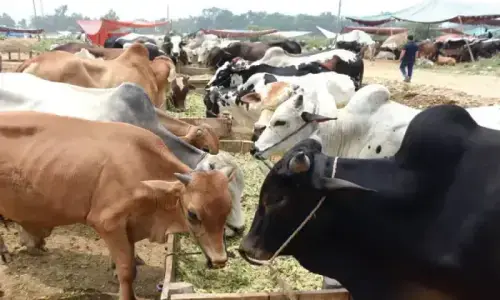
KARACHI: “I can’t afford to send my kid to school when there is hunger at home. I spend the whole day looking for labour now while my only son, who used to be a school student, now tends to animals,” Irshad Ali, a resident of Ghulam Nabi Jamali village of tehsil Usta Mohammad, explains how the floods that struck Jafarabad district in Balochistan about three months ago have affected his life.
It’s the second time in two years that Jafarabad, along with Nasirabad and Jhal Magsi districts, was badly affected by floods. The region had seen disaster in 2010 too.
According to non-governmental organisations based in Jafarabad and Nasirabad, the government is playing no role in rehabilitation efforts while NGOs’ efforts are too small to cater for the needs of thousands of people in flood-hit areas of Balochistan.
Of the four tehsils of Jafarabad, water is still standing in large parts of 15 to 16 union councils located in two tehsils (Ghandakha and Usta Mohammad) while five union councils of Nasirabad are inundated.
The organisations also dispute the official data about the losses and damage caused by the floods and argue that they are much higher than what the government claims.
“At times I return empty-handed and we can barely manage one meal in a day,” Irshad regrets. Ghulam Nabi Jamali village is part of Mehrabpur union council, which is among the worst flood-hit areas in Balochistan.
People who took refuge in relief camps have now returned to their village as water has completely receded after causing massive death and destruction. “We haven’t received any support from anyone in rehabilitation, although we have lost our people, our crop and animals and are now finding it hard to sustain our lives,” says Lutf Ali of the same village.
The floods, according to villagers, had destroyed rice crop grown on a large area in the village and left the land unproductive for any other crop except for mustard which, they said, now had been sown and would be ready for harvest in March or April.
“It wasn’t just rainwater. Water had also come from different cities.
“It was dirty and stinking. The land can be replenished only be river water now. We have to grow mustard because once sown the crop doesn’t require water,” adds another villager.
Of the 28 houses in the village, 19 were in good shape, thanks to an NGO which had built homes with bricks for some after the 2010 floods.
The village school hasn’t officially been opened after the floods even though the only teacher posted at the school was said to be coming there with regularity.
Apart from employment, the biggest problem at the village was the absence of a facility for clean drinking water.
“Every day, we have to walk long distances just to fetch water. It consumes a lot of our time and energies. Our children are sick and there is no doctor here,” said Nusrat, a mother of three children.
According to official statistics, the calamity claimed the lives of 156 people in Balochistan — 104 in Nasirabad, 22 in Jafarabad and the rest in Kachhi, Dera Bugti, Killa Saifullah, Khuzdar, Sibi, Musakhel, Barkhan and Lasbela.
Over 750 villages were affected, 9,194 heads of cattle perished, crops spread over 452,588 acres were damaged and more than 174,000 houses were affected. Over 2,000 educational institutions and 157 health facilities suffered one way or the other.
“More than 2,000 people lost their lives in floods in Nasirabad alone.
Of the 24 union councils in Nasirabad, 10 have seen widespread damage.
The road network exists no more. Water supply, education and health facilities have been crippled in Jafarabad, Nasirabad and Jhal Magsi districts,” says Abdul Karim of The Needs, an NGO operating in Nasirabad.
“The total affected area of crop in Nasirabad is 378,149 acres. More than 5,000 heads of cattle perished while over 97,000 houses were damaged.
Irrigation canals have been rendered non-functional,” he said.
Union councils of Bedar, Kona Tambu, Baba Kot, Abdullah Bari, Garhi Rehman and Manjhoo Shori of Nasirabad district were still under water, he said. “People are working on self-help basis. There is a desperate need for food, medicines, winter clothing and other items.”
Manzoor Ahmed, chairman of Islamic Education Welfare Society, an NGO based in Jafarabad, said the floods had caused massive devastation. The absence of a 2010-like response by NGOs had contributed to making the outlook bleak, he bemoaned.
“The conditions in which the poor are forced to live in could create a law and order situation. There is disappointment all over. It’s unfortunate that the government hasn’t launched an international appeal for help as it did in 2010,” he said.